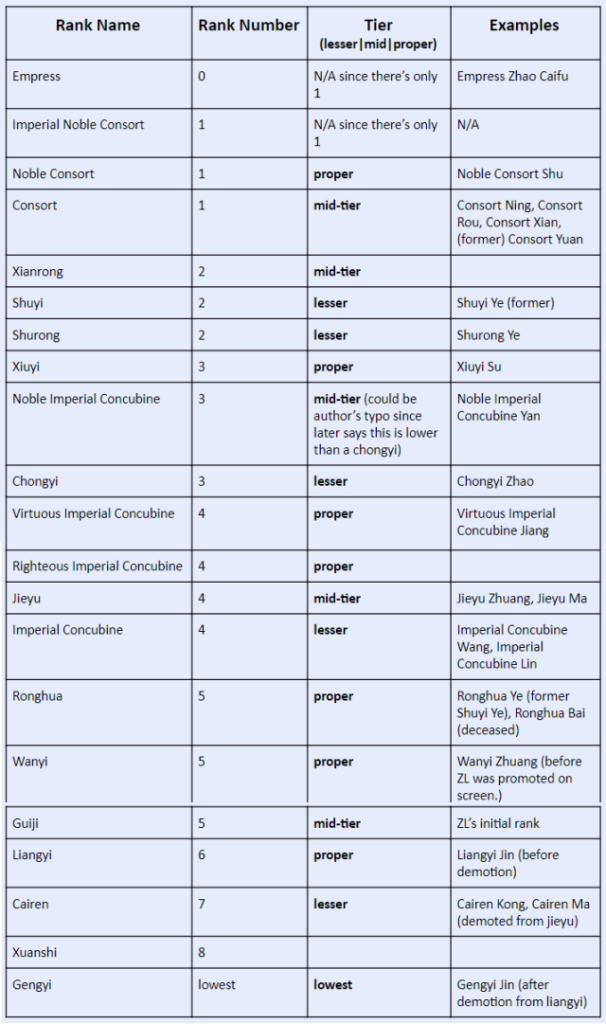
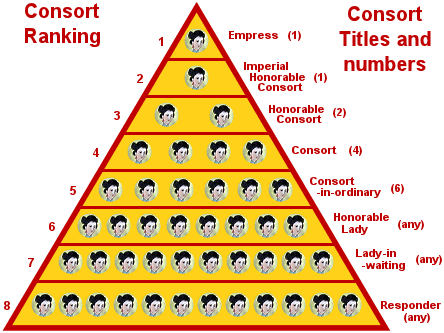
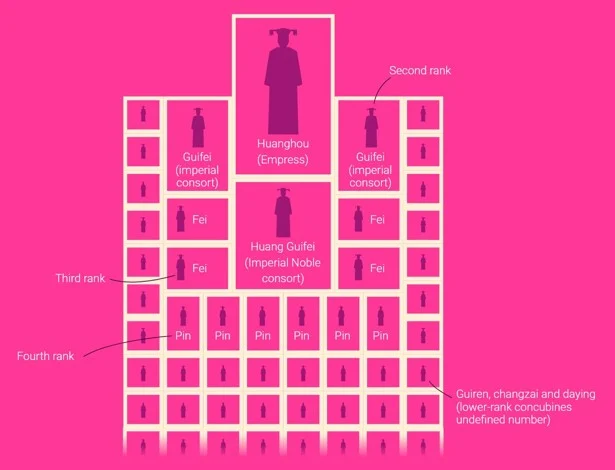
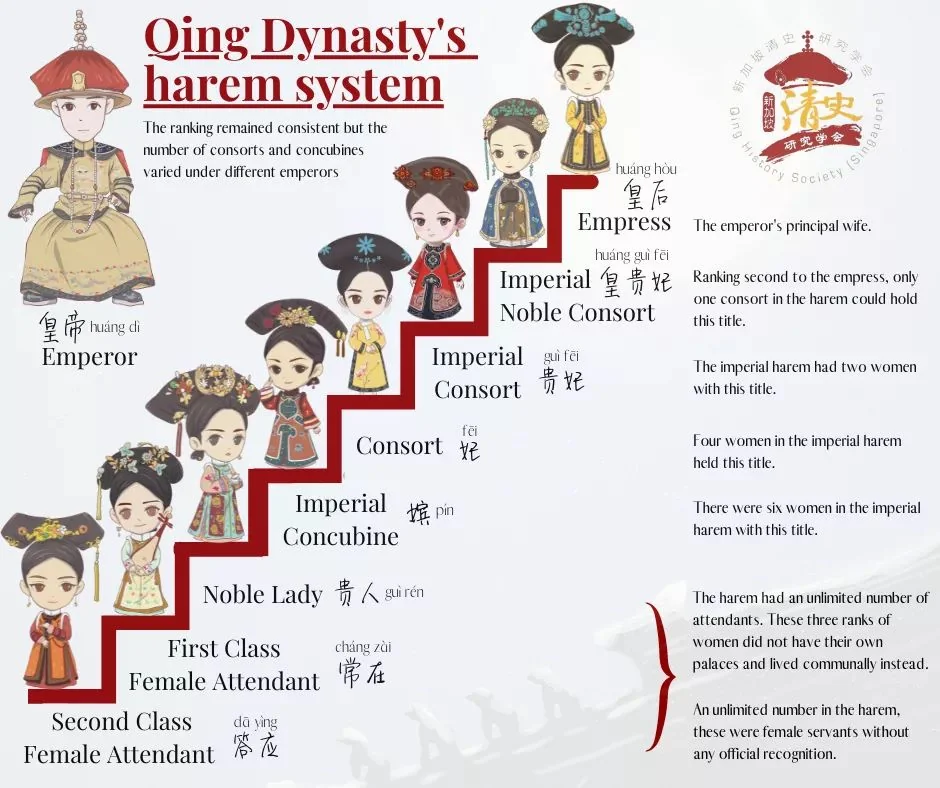
The ranking system for an emperor’s wives and consorts was detailed and varied across different Chinese dynasties. Here’s a more comprehensive breakdown, including variations from different dynasties like the Tang (618–907), Song (960–1279), Ming (1368–1644), and Qing (1644–1912) Dynasties.
Factors influencing rank:
Family background: Women from prominent families often received higher ranks.
Emperor’s favor: A concubine who gained the emperor’s favor could be elevated in rank.
Ability to bear children: Concubines who gave birth to the emperor’s heirs often received higher status.
1. Empress (皇后, Huánghòu) – First Rank
The highest-ranking wife of the emperor, his main consort.
She had authority over all the emperor’s consorts and the harem.
Wore the Phoenix Crown (凤冠, Fèngguān) as a symbol of power.
The Empress gave birth to the heir (Crown Prince) whenever possible.
2. Imperial Noble Consort (皇贵妃, Huáng Guìfēi) – Second Rank
Just below the empress but still held significant influence.
This rank was not always present in earlier dynasties but became common in the Ming and Qing Dynasties.
3. Noble Consort (贵妃, Guìfēi) – Third Rank
Higher than most other consorts but below the Imperial Noble Consort.
Usually, one or two women held this title.
4. Consort (妃, Fēi) – Fourth Rank
A mid-tier consort with noble status.
In the Qing Dynasty, there were typically four Consorts at a time.
5. Imperial Concubine (嫔, Pín) – Fifth Rank
A recognized consort but of lower status.
Had limited influence in court matters.
6. Noble Lady (贵人, Guìrén) – Sixth Rank
The lowest official rank in the imperial harem.
Some noble ladies could rise in rank if favored by the emperor.
7. First Attendant (常在, Chángzài) – Seventh Rank
Lower than a Noble Lady but still part of the emperor’s harem.
Had minimal influence but could be promoted.
8. Second Attendant (答应, Dāyìng) – Eighth Rank
The lowest recognized rank.
Mostly served the emperor without real power.
9. Palace Maids (宫女, Gōngnǚ) – Unranked
Not official consorts but worked in the inner palace.
Could sometimes be promoted if favored by the emperor.
Other Titles (Special Cases & Retired Consorts)
Empress Dowager (皇太后, Huáng Tàihòu) – The widow of a deceased emperor, often the mother of the new emperor.
Grand Empress Dowager (太皇太后, Tài Huáng Tàihòu) – The grandmother of the reigning emperor.
Virtuous Consorts (昭仪, Zhāoyí; 修仪, Xiūyí, etc.) – Titles used in some dynasties like the Tang, referring to special-ranked concubines with unique responsibilities.
Each dynasty had slight variations, but this structure provides a detailed view of the emperor’s wives’ ranks throughout Chinese history. Would you like information on a specific dynasty or any famous empresses? 😊
Mersenne Prime and Mersenne Twister are two distinct mathematical/computational concepts that share part of their name but serve completely different purposes. Here’s a breakdown of the differences:
1. Mersenne Prime
Definition: A Mersenne prime is a special type of prime number that can be expressed in the form:
Mn=2n−1
where nnn is a positive integer and MnM_nMn is prime.
Example: For n=2n = 2n=2, M2=22−1=3M_2 = 2^2 – 1 = 3M2=22−1=3 (which is prime). For n=3n = 3n=3, M3=23−1=7M_3 = 2^3 – 1 = 7M3=23−1=7 (which is also prime). However, not all numbers of the form 2n−12^n – 12n−1 are prime (e.g., 24−1=152^4 – 1 = 1524−1=15, which is not prime).
Applications:
Mersenne primes are closely related to perfect numbers, which are integers equal to the sum of their proper divisors.
They are of interest in number theory and are used in cryptographic algorithms.
In summary, while Mersenne primes are a special class of numbers studied in mathematics, the Mersenne Twister is a practical tool for random number generation in computing, inspired by the mathematical properties of Mersenne primes.
Why Are Mersenne Primes Special?
Rare: Not all numbers of the form 2n−12^n – 12n−1 are prime; nnn must itself be prime for 2n−12^n – 12n−1 to have a chance of being prime, but even then, not all such numbers are prime.
Connection to Perfect Numbers: Every Mersenne prime is associated with an even perfect number (a number equal to the sum of its proper divisors).
2. Mersenne Twister
Definition: The Mersenne Twister is a pseudorandom number generator (PRNG) developed by Makoto Matsumoto and Takuji Nishimura in 1997 and designed for generating sequences of random numbers with a very long period. It is named “Mersenne” because its period length is a Mersenne prime, specifically 219937−12^{19937} – 1219937−1.
Purpose: To generate sequences of numbers that approximate true randomness for applications in simulations, games, statistical sampling, and more.
Key Characteristics:
Period: Extremely long period (219937−12^{19937} – 1219937−1).
Speed: Very fast and efficient for generating random numbers.
Quality: Produces numbers with a uniform distribution and passes many statistical tests for randomness.
Applications:
Widely used in simulations, cryptographic applications (though not cryptographically secure), and any situation requiring high-quality random number generation.
Efficiency:
It is computationally efficient, capable of generating random numbers quickly, making it suitable for applications requiring large volumes of random data.
Quality of Randomness:
The Mersenne Twister passes most standard statistical tests for randomness, ensuring the generated sequences appear random and unbiased.
How Does It Work?
The Mersenne Twister works by maintaining an internal state array of size N=624N = 624N=624, with each element being a 32-bit integer. The generator progresses by:
Initialization:
The state array is initialized using a seed value (often a single integer).
Recurrence Relation:
The generator uses a linear recurrence relation to update its state. At each step, a new value is computed by combining elements of the state array using bitwise operations and a carefully chosen set of constants.
Tempering:
The output is “tempered” (processed further) to improve statistical properties and ensure the generated numbers are distributed uniformly.
Applications
Simulations:
Widely used in Monte Carlo simulations and scientific modeling where high-quality random numbers are required.
Games:
Randomness in video games, such as dice rolls, loot drops, or random events, often relies on the Mersenne Twister.
Statistical Sampling:
Random sampling from datasets in statistics and machine learning.
Randomized Algorithms:
Used in algorithms requiring randomness, such as quicksort or hash table probing.
Strengths
Extremely Long Period: The massive period ensures that the generator doesn’t repeat its sequence in realistic use cases.
Speed: Generates random numbers efficiently.
High Quality: It meets strict randomness requirements, making it suitable for most non-cryptographic applications.
Limitations
Not Cryptographically Secure:
The Mersenne Twister is predictable if an attacker knows part of its internal state or a sequence of generated numbers. For cryptographic purposes, use secure PRNGs like Cryptographically Secure PseudoRandom Number Generators (CSPRNGs).
Memory Usage:
The state array of size 624 integers (about 2.5 KB) is larger than simpler PRNGs like the Linear Congruential Generator (LCG).
Initialization Time:
Initializing the state array can be slower compared to simpler generators.
Variants
Several variants of the Mersenne Twister have been developed to address specific use cases:
MT19937:
The original 32-bit version of the Mersenne Twister.
MT19937-64:
A 64-bit version of the Mersenne Twister, designed for 64-bit systems.
TinyMT:
A smaller version with reduced state size, designed for embedded systems or applications with limited memory.
How to Use the Mersenne Twister in Programming
Most modern programming languages and libraries include the Mersenne Twister as the default or available PRNG:
Python
import random
random.seed(42) # Initialize the generator with a seed
print(random.random()) # Generate a random float between 0 and 1
C++
#include <random>
std::mt19937 mt(42); // Initialize with a seed
std::uniform_real_distribution<double> dist(0.0, 1.0);
double random_value = dist(mt); // Generate a random number
Key Differences
Aspect
Mersenne Prime
Mersenne Twister
Nature
Mathematical concept (prime number).
Algorithm for pseudorandom number generation.
Form
2n−12^n – 12n−1, where nnn is a positive integer and 2n−12^n – 12n−1 is prime.
Uses a long recurrence relation to generate random numbers.
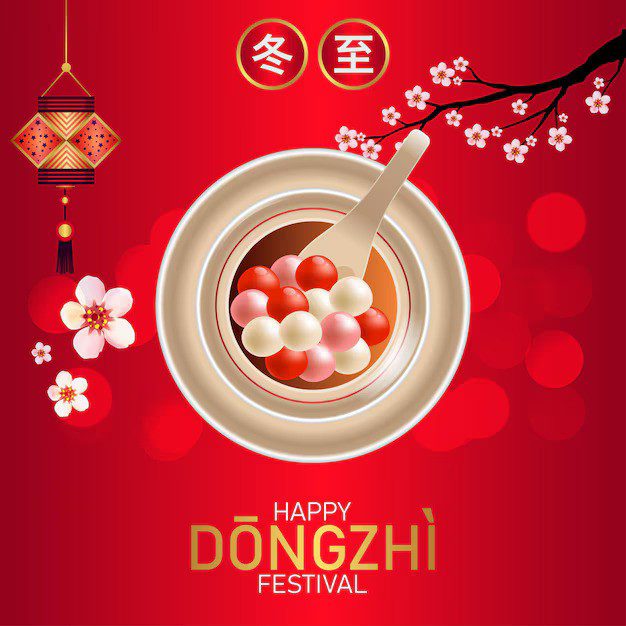
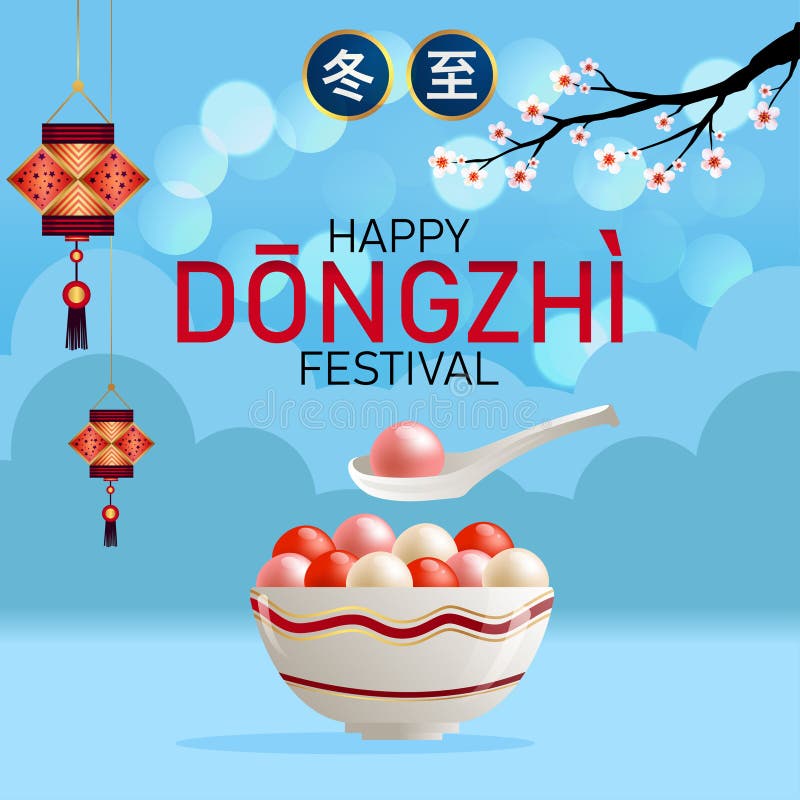
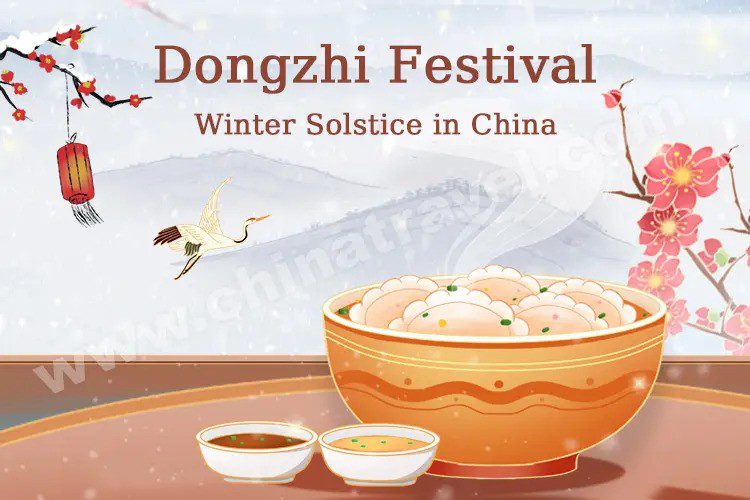
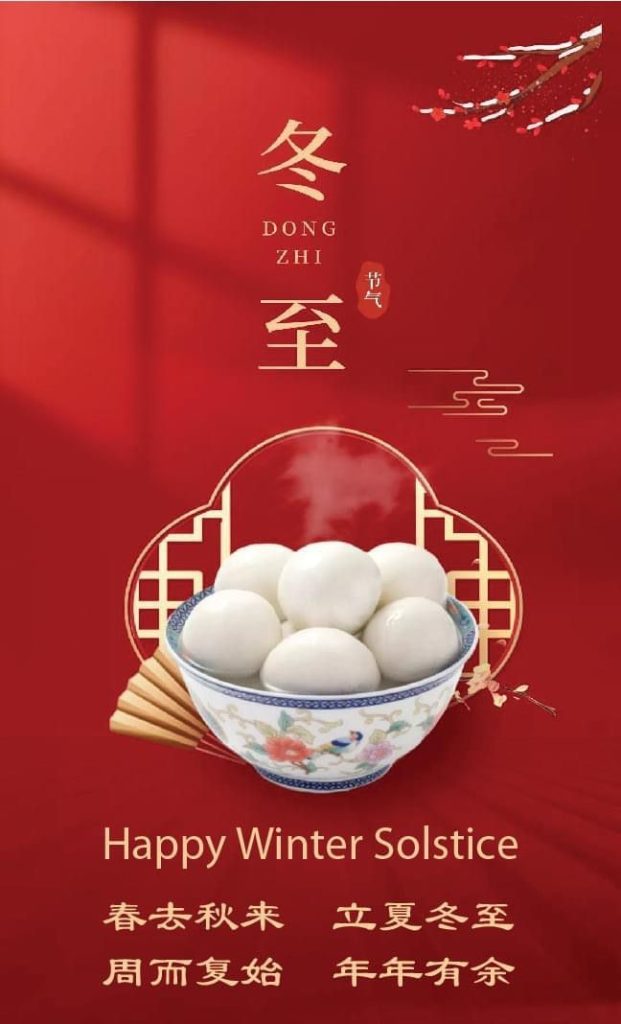
Dalam bahasa Mandarin, kata “Dong” berarti “musim dingin” sementara “Zhi” berarti “kedatangan” yang memberikan arti harfiah dari festival ini “datangnya musim dingin”. Dongzhi merayakan titik balik matahari musim dingin, biasanya sekitar tanggal 21 hingga 23 Desember, dan dirayakan pada malam terpanjang dalam setahun. Melambangkan kemenangan cahaya atas kegelapan, Dongzhi, melambangkan bahwa hari-hari akan mulai bertambah panjang dan membawa rasa keseimbangan dan harmoni pada kehidupan manusia. Berdasarkan kepercayaan Tiongkok tentang yin yang, “Yang” melambangkan energi positif, kehangatan, dan cahaya. Setelah Festival Dongzhi, siang hari akan berangsur-angsur memanjang, karena “Yang” juga akan bertambah. Dipercaya oleh sebagian orang bahwa itu adalah hari ketika Dewa Dapur pergi ke surga untuk melaporkan kepada Kaisar Giok tentang perilaku sebuah keluarga.
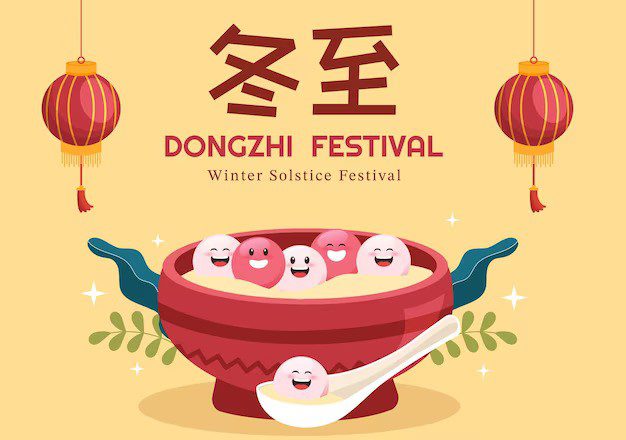
Tang Yuan, bola-bola pangsit beras ketan, adalah minuman hangat tradisional yang terbuat dari jahe. Bola-bola ketan dalam wedang ronde biasanya berisi kacang tumbuk dan gula merah.
1. Apa itu Tang Yuan?
Tang Yuan (汤圆) adalah bola-bola tepung ketan yang biasanya direbus dan disajikan dalam kuah manis atau gurih. Tang Yuan memiliki makna simbolis dalam budaya Tionghoa:
Bentuk bulat: Melambangkan kebersamaan, keharmonisan, dan persatuan keluarga.
Rasa manis: Melambangkan kehidupan yang penuh berkah dan kebahagiaan.
2. Hubungan Tang Yuan dengan Festival Dong Zhi
Dong Zhi Festival (冬至), yang berarti “Musim Dingin Tiba,” adalah salah satu festival penting dalam budaya Tionghoa. Biasanya dirayakan sekitar 21-23 Desember, saat siang hari terpendek dalam setahun di belahan bumi utara. Pada festival ini, makan Tang Yuan menjadi tradisi untuk:
Menyambut perubahan musim.
Mempererat ikatan keluarga.
Melambangkan kedewasaan dan tahap kehidupan baru.
Tang Yuan disajikan dalam kuah jahe manis untuk menghangatkan tubuh selama musim dingin.
3. Tang Yuan dalam Tradisi Chinese Indonesia
Di Indonesia, tradisi makan Tang Yuan tidak hanya dilakukan pada Dong Zhi, tetapi juga dalam beberapa perayaan lain, seperti:
Imlek (Tahun Baru Imlek): Tang Yuan dimakan sebagai simbol keberuntungan dan kebersamaan keluarga.
Pernikahan atau Kelahiran: Disajikan sebagai doa untuk keharmonisan dan kebahagiaan keluarga.
Upacara Sembahyang Leluhur: Sebagai persembahan untuk leluhur, melambangkan doa untuk keberkahan keluarga.
4. Cara Membuat Tang Yuan
Bahan Utama:
Tepung ketan
Air
Pewarna makanan (opsional)
Gula merah atau jahe untuk kuah manis
Langkah-langkah:
Campur tepung ketan dengan sedikit air hingga menjadi adonan yang bisa dibentuk.
Bentuk adonan menjadi bola-bola kecil.
Rebus bola-bola dalam air mendidih hingga mengapung.
Sajikan dengan kuah manis yang terbuat dari gula merah, jahe, dan air.
5. Makna Filosofis Tang Yuan di Indonesia
Bagi komunitas Tionghoa Indonesia, makan Tang Yuan adalah cara untuk:
Menghormati tradisi leluhur: Merayakan kebersamaan dengan keluarga.
Menghubungkan generasi: Biasanya dibuat bersama-sama oleh keluarga, melibatkan orang tua, anak, dan cucu.
Melestarikan budaya: Sebagai salah satu bagian penting dari warisan budaya Tionghoa.
6. Variasi Tang Yuan di Indonesia
Di Indonesia, Tang Yuan sering dimodifikasi dengan cita rasa lokal:
Isi gula merah cair atau kacang tanah manis: Sebagai pengaruh budaya Nusantara.
Kuah santan: Menggunakan bahan khas Indonesia untuk memberikan rasa gurih-manis.
Kesimpulan
Festival Tang Yuan adalah bagian penting dari tradisi Tionghoa, baik di China maupun Indonesia. Dalam konteks Indonesia, Tang Yuan tidak hanya menjadi makanan tradisional tetapi juga simbol keharmonisan keluarga, kebahagiaan, dan keberuntungan. Dengan adaptasi lokal, Tang Yuan tetap menjadi salah satu elemen budaya yang dilestarikan oleh komunitas Tionghoa di Indonesia.
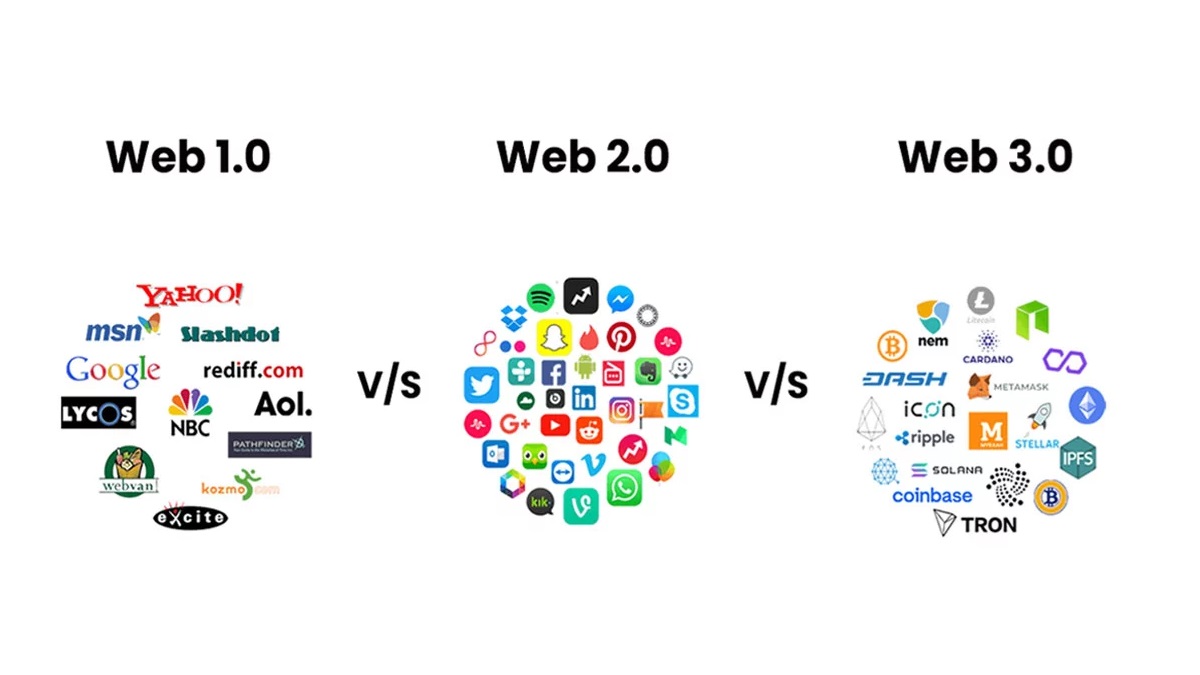
Web1, Web2, and Web3 are terms that describe the evolution of the internet, each phase marking a shift in how users interact with and experience the web. Here’s a breakdown of each:
1. Web 1.0 (The Static Web)
Web1, or the Static Web, refers to the early phase of the internet, which lasted from the 1990s to the early 2000s. This phase is characterized by:
Static content: Webpages were mostly read-only and provided information without any user interaction.
Personal websites and portals: Most websites were simple, static pages where users could access information but not contribute or interact with it.
Minimal user interaction: Users were passive consumers of content, as there were no platforms for collaboration or participation.
Basic technology: Web 1.0 primarily used HTML, images, and basic design elements.
Example: A typical Web1 site would be like an online brochure or a static information page, such as early personal websites or news portals.
2. Web 2.0 (The Social and Interactive Web)
Web2, also known as the Social Web or Interactive Web, emerged in the early 2000s and continues today. It represents a more dynamic, user-focused web. Key characteristics of Web2 include:
User-generated content: Users could now create and share their own content, such as blogs, videos, and social media posts.
Interactivity and collaboration: Platforms allowed for two-way communication, with websites like Facebook, YouTube, and Wikipedia enabling users to interact and contribute.
Dynamic web applications: Webpages became more interactive, using technologies like AJAX, making them responsive and customizable without reloading entire pages.
Community-driven platforms: Websites became spaces for users to participate in discussions, share opinions, and collaborate with each other.
Data-driven business models: Platforms like Facebook, Twitter, and Google grew by collecting and monetizing user data, primarily through advertising.
Example: Platforms like Facebook, YouTube, Instagram, and collaborative tools like Google Docs are products of Web2.
3. Web 3.0 (The Decentralized Web)
Web3, often referred to as the Decentralized Web or Semantic Web, is the most recent and emerging phase of the internet. It emphasizes user control, decentralization, and improved intelligence. Key features include:
Decentralization: Web3 is powered by blockchain technology, which distributes control over data and applications across a peer-to-peer network, rather than being controlled by centralized entities (like large tech companies).
User data ownership: Unlike Web2, where platforms own user data, Web3 aims to give users full ownership of their data, with privacy and security being central concerns.
Smart contracts: Web3 enables smart contracts, which are self-executing agreements stored on the blockchain. These automate transactions without intermediaries.
Cryptocurrencies and digital economies: Web3 integrates digital assets like cryptocurrencies and tokens, allowing users to participate in decentralized finance (DeFi) and own unique digital items via NFTs (Non-Fungible Tokens).
Semantic Web: The goal is also to make the web more intelligent, allowing machines to better understand and process information, making searches and interactions more relevant and personalized.
Example: Decentralized platforms such as Ethereum, IPFS, Decentralized Finance (DeFi) applications, and NFT marketplaces represent the Web3 era.
Summary of Differences
Phase
Web 1.0
Web 2.0
Web 3.0
Era
1990s to early 2000s
Early 2000s to present
Emerging (2020s and beyond)
Content
Static, read-only
Dynamic, user-generated
Decentralized, user-controlled
Interaction
Passive
Interactive, social
Peer-to-peer, decentralized
Technology
HTML, basic webpages
AJAX, APIs, social media
Blockchain, smart contracts, AI
Data control
Owned by website owners
Controlled by large platforms
Controlled by users, decentralized
Web3 represents the future of the internet, focusing on decentralization, enhanced privacy, and user sovereignty over their data and digital assets.
A “996” work schedule refers to an unofficial work schedule (9a.m. ~ 9p.m., 6 days a week) that has been gaining in popularity. Serving a company that encourages the “996” work schedule usually means working for at least 60 hours a week.
996 work system: arrive at work at 9 am every day and work until 9 pm. Work 6 days a week.
955 work system: arrive at work at 9 am every day and work until 5 pm. Work 5 days a week.
944 work system: arrive at work at 9 am every day and work until 4 pm. Work 4 days a week.
The following list of companies basically do not belong to the 996 companies, and are relatively close to the 955/965 level, but it still depends on the department and region, and cannot be guaranteed to be completely accurate.
It cannot be guaranteed that all departments are at the level of 955/10-6-5/965/10-7-5
Even if the average level of the department is 955/10-6-5/965/10-7-5, you may still have to work overtime part of the time.
Some departments of some companies in the list may have 975 or even 985 students. Don’t generalize.
Some companies in the list may have some or even more departments with 945, 10-5-5 or 11-6-5, so we have included them in the list.
Currently, most of the companies on the list are in Shanghai because I am in Shanghai and have a relatively good understanding of the situation in Shanghai. This does not mean that most of the 955 companies are in Shanghai. You are welcome to continue voting, and I will add more companies based on the voting results.
About the future
Always know what you want.
What I want now is an environment where I can learn English and technology, so that my choices in the future will not be limited to China, but will be from all over the world.
If you are nostalgic for the high salaries of domestic large companies
If you are afraid of going to a strange place
If you seek stability and are unwilling to change
Please stay in the country, come on.
If you like a challenge
If you like to experience different life
If you yearn for equal human rights, freedom of speech, and a society ruled by law
The world is so big, go out and see it.
There are many things you can’t change, but you can choose to leave
Work System
Hours per Day
Days per Week
Example Company/Industry
Description
996
9 am – 9 pm
6
Some tech companies in China (e.g., Alibaba)
Long hours, prevalent in tech and startup culture in China.
955
9 am – 5 pm
5
Standard corporate companies worldwide
Standard work schedule in many countries.
944
9 am – 4 pm
4
Some creative agencies and consulting firms
Shorter workweek with slightly reduced daily hours.
888
8 am – 8 pm
4 (per week)
Manufacturing industry with rotating shifts
Longer daily hours, common in shift-based industries.
410
10 hours
4
Some government jobs and tech companies
Four-day workweek with 10-hour shifts.
987
9 am – 8 pm
7
Startups in high-growth phases
Intense schedule with no days off for quick scaling.
774
7 am – 7 pm
4
Healthcare workers and emergency services
Long shifts but three consecutive days off.
582
5 am – 8 pm
2
Part-time workers in retail or emergency services
Very long shifts with significant days off.
998
9 am – 9 pm
4 (per week)
IT support companies with alternate workweeks
Alternating week schedule with long daily hours.
1045
10 am – 4 pm
5
Freelancers and part-time workers
Shorter daily shifts for a flexible schedule.
663
6 am – 6 pm
3
Oil and gas industry workers, emergency responders
Intensive shifts with more days off.
964
9 am – 6 pm
4
Innovative tech companies focusing on work-life balance
Balanced workweek for better work-life balance.
9969
9 am – 9 pm
6 (for 9 months)
Construction projects, startups with intense deadlines
Looking to elevate your website’s SEO, gain authority, and reach a highly relevant audience? josuamarcelc.com is now offering Premium Guest Post Placement for just $50 per article!
With solid domain authority and a tech-savvy audience, our platform is an ideal choice for businesses in software development, PHP, web engineering, and digital marketing niches.
✅ What’s Included in the $50 Package:
📄 500+ Words of Original Content We craft a professionally written article tailored to your niche, ensuring it delivers value to our readers and aligns with your goals.
🔗 1 Do-Follow Link + Keyword You choose one keyword and one target URL. We’ll insert it naturally into the content to ensure maximum SEO benefit.
📈 Authoritative Placement Gain a high-quality backlink from a domain with growing authority and authentic traffic.
💡 Why Publish on josuamarcelc.com?
SEO Benefits: Improve your search rankings with contextual, do-follow backlinks.
Relevant Audience: Targeted readers interested in PHP, software, and tech.
Fast Turnaround: Get your content live quickly with clear communication.
Affordable & Scalable: Start small or scale with generous bulk discounts.
🌱 Our Ethical Standards
We believe in supporting healthy, impactful businesses. That’s why we strictly do not accept guest posts that promote or link to:
🚫 Drugs 🚫 Human trafficking 🚫 Gambling or betting 🚫 Pornography or adult content 🚫 Black hat SEO techniques or link schemes 🚫 Scams or phishing or deceptive business models
Our mission is to help ethical businesses grow and contribute to a healthier, more responsible digital world.
📋 Guest Post Guidelines:
Content Type: We only accept professional, informative, and valuable articles.
Prohibited Topics: No content related to pornography, gambling, drugs, spam, or scams.
Link Quality: Only relevant, high-quality URLs will be accepted.
Niche Compatibility: Content must relate to software, tech, or business topics.
🛠️ How to Get Started
Email us with your topic, keyword, and target URL.
Once approved, we’ll handle the writing and publishing.
Your post goes live shortly after payment.
📌 FAQ — Frequently Asked Questions
1. Can you provide samples? Yes! Contact us to request recent examples of published guest posts.
2. Are these posts on a PBN (Private Blog Network)? No. Our websites are real, with genuine traffic and organic search value.
3. Can I choose the niche of the site? Absolutely. Contact us to explore our available niche-specific domains.
4. Do you offer bulk discounts? Yes! We offer lifetime tiered discounts:
Tier
Posts Ordered
Discount
1
5–10
5%
2
11–15
10%
3
16–20
15%
4
21–30
20%
5
31–50
25%
6
51–99
30%
7
100+
35%
Discounts are lifetime-based, meaning once you reach a tier, you keep that discount forever.
5. What’s your refund policy? You may request a refund any time before the delivery of the report. Once the guest post is delivered with links, no refunds will be issued unless we fail to publish the post as agreed.
6. What is your TAT (Turnaround Time)? Guest posts are typically delivered within 2–4 business days after payment. Bulk orders may take slightly longer depending on volume and site queue.
🎯 Ready to Amplify Your Brand?
Whether you’re improving SEO, boosting authority, or increasing visibility, a guest post on josuamarcelc.com is a smart, budget-friendly step.
📩 Contact us now with your topic, keyword, and URL — and let’s publish something powerful.
Detect, Respond, and Recover from Cloud Cybersecurity Attacks
This is the fourth of five courses in the Google Cloud Cybersecurity Certificate. In this course, you’ll focus on developing capabilities in logging, security, and alert monitoring, along with techniques for mitigating attacks. You’ll gain valuable knowledge in customizing threat feeds, managing incidents, handling crisis communications, conducting root cause analysis, and mastering incident response and post-event communications. Using Google Cloud tools, you’ll learn to identify indicators of compromise and prepare for business continuity and disaster recovery. Alongside these technical skills, you’ll continue updating your resume and practicing interview techniques.
Put It All Together: Prepare for a Cloud Security Analyst Job
This is the fifth of five courses in the Google Cloud Cybersecurity Certificate. In this course, you’ll combine and apply key concepts such as cloud security principles, risk management, identifying vulnerabilities, incident management, and crisis communications in an interactive capstone project. Additionally, you’ll finalize your resume updates and put to practice all the new interview techniques you’ve learned, preparing you to confidently apply for and interview for jobs in the field.
Cloud Security Risks: Identify and Protect Against Threats
This is the third of five courses in the Google Cloud Cybersecurity Certificate. In this course, you’ll explore the principles of identity management and access control within a cloud environment, covering key elements like AAA (Authentication, Authorization, and Auditing), credential handling, and certificate management. You’ll also explore essential topics in threat and vulnerability management, cloud-native principles, and data protection measures. Upon completing this course, you will have acquired the skills and knowledge necessary to secure cloud-based resources and safeguard sensitive organizational information. Additionally, you’ll continue to engage with career resources and hone your interview techniques, preparing you for the next step in your professional journey.
Strategies for Cloud Security Risk Management
This is the second of five courses in the Google Cloud Cybersecurity Certificate. In this course, you’ll explore widely-used cloud risk management frameworks, exploring security domains, compliance lifecycles, and industry standards such as HIPAA, NIST CSF, and SOC. You’ll develop skills in risk identification, implementation of security controls, compliance evaluation, and data protection management. Additionally, you’ll gain hands-on experience with Google Cloud and multi-cloud tools specific to risk and compliance. This course also incorporates job application and interview preparation techniques, offering a comprehensive foundation to understand and effectively navigate the complex landscape of cloud risk management.
Introduction to Security Principles in Cloud Computing
This is the first of five courses in the Google Cloud Cybersecurity Certificate. In this course, you’ll explore the essentials of cybersecurity, including the security lifecycle, digital transformation, and key cloud computing concepts. You’ll identify common tools used by entry-level cloud security analysts to automate tasks.
Introduction to Responsible AI
This is an introductory-level microlearning course aimed at explaining what responsible AI is, why it’s important, and how Google implements responsible AI in their products. It also introduces Google’s 7 AI principles.
Responsible AI: Applying AI Principles with Google Cloud
This course, Responsible AI: Applying AI Principles with Google Cloud – Locales, is intended for non-English learners. If you want to take this course in English, please enroll in Responsible AI: Applying AI Principles with Google Cloud. As the use of enterprise Artificial Intelligence and Machine Learning continues to grow, so too does the importance of building it responsibly. A challenge for many is that talking about responsible AI can be easier than putting it into practice. If you’re interested in learning how to operationalize responsible AI in your organization, this course is for you. In this course, you will learn how Google Cloud does this today, together with best practices and lessons learned, to serve as a framework for you to build your own responsible AI approach.
Prompt Design in Vertex AI
Complete the introductory Prompt Design in Vertex AI skill badge to demonstrate skills in the following: prompt engineering, image analysis, and multimodal generative techniques, within Vertex AI. Discover how to craft effective prompts, guide generative AI output, and apply Gemini models to real-world marketing scenarios. A skill badge is an exclusive digital badge issued by Google Cloud in recognition of your proficiency with Google Cloud products and services and tests your ability to apply your knowledge in an interactive hands-on environment. Complete this skill badge course and the final assessment challenge lab to receive a skill badge that you can share with your network.
Introduction to Large Language Models
This is an introductory level micro-learning course that explores what large language models (LLM) are, the use cases where they can be utilized, and how you can use prompt tuning to enhance LLM performance. It also covers Google tools to help you develop your own Gen AI apps.
Introduction to Generative AI
This is an introductory level microlearning course aimed at explaining what Generative AI is, how it is used, and how it differs from traditional machine learning methods. It also covers Google Tools to help you develop your own Gen AI apps.
Derive Insights from BigQuery Data
Complete the introductory Derive Insights from BigQuery Data skill badge to demonstrate skills in the following: write SQL queries, query public tables, load sample data into BigQuery, troubleshoot common syntax errors with the query validator in BigQuery, and create reports in Looker Studio by connecting to BigQuery data. A skill badge is an exclusive digital badge issued by Google Cloud in recognition of your proficiency with Google Cloud products and services and tests your ability to apply your knowledge in an interactive hands-on environment. Complete this skill badge course, and the final assessment challenge lab, to receive a skill badge that you can share with your network.
Mengetahui cara yang tepat untuk menyapa anggota keluarga yang berbeda merupakan bagian penting dalam menguasai kosakata bahasa Mandarin. Hal ini tidak hanya akan menumbuhkan hubungan yang lebih dalam, tetapi juga membantu menjaga nilai-nilai yang telah dijunjung tinggi dan diwariskan dari generasi ke generasi. Nilai-nilai tersebut meliputi pentingnya hubungan keluarga dalam budaya Tiongkok, bakti kepada orang tua, dan penghormatan kepada leluhur.
Baik Anda bagian Chinese sekadar tertarik dengan budaya, bahasa, dan tradisi mereka, mempelajari kosakata bahasa Mandarin dan nuansa di baliknya akan membantu Anda memperoleh pemahaman yang lebih kaya tentang jalinan budaya Chinese yang semarak.
Disclaimer: ini khusus untuk dialek khek, jarang Chinese yang khek (biasa dari Bangka Belitung ato Singkawang)
Ching ngin = orang yang satu keluarga (generalized)
kung kung = kakek
pho pho = nenek
koko = kakak laki laki
aso = istri kakak laki laki
cece = kakak perempuan
ci cong = suami kakak perempuan
Untuk sisi nyokap:
khiu khiu = kakak/adek laki laki nyokap
khiu me = istri kakak/adek laki laki nyokap
thai ji = kakak perempuan nyokap
thai ji cong = suami kakak perempuan nyokap
ji ji = adik perempuan nyokap
ji chong= suami adik perempuan nyokap
Untuk sisi bokap
pak pak = kakak laki laki bokap
pak me = istri kakak laki laki bokap
thai ku = kakak perempuan bokap
thai ku cong = suami kakak perempuan bokap
suk suk = adik laki laki bokap
suk me = istri adik laki laki bokap
ku ku = adik perempuan bokap
ku cong = suami adik perempuan bokap
khek:
kalo yg seangkatan ya panggil koko / cici kalo lebih tua
gw selalu panggil pak pak *nama* (misalnya pak pak atong) buat kakak adek bokap cowo, belakangan bokap pernah bilang harusnya ga usah pake nama tapi ada urutannya di depan: thai pak buat paling tua, nyi pak buat anak cowo kedua, sam pak buat anak cowo ketiga.. bokap punya sodara cowo lebih muda yg gw panggil suk suk, sepupu gw yg lahir dari kakak cowo bokap jg panggil bokap gw suk suk
ku ku buat kakak adek bokap cewe (misalnya ku ku a lie), sama kaya di atas: thai ku buat paling tua, nyi ku buat kedua
other om dan tante sepupu bokap gw panggil pak pak dan ku ku
kakek nenek gw panggil kung kung dan po po
tiochiu, disclaimer tho, nyokap lebih ga peduli soal panggilan2:
kalo seangkatan panggil koko / cici
kakak adek nyokap cewe gw panggil pake ie ie *nama* (misalnya ie2 san chai), harusnya ada urutan juga.. yg paling tua gw ga tau apa, tapi yg kedua itu ji ie
kakak adek nyokap cowo gw panggil om, tapi ada satu paman ketiga yang gw panggil Sa (tiga) Ku (om)
other om dan tante sepupu nyokap gw panggil om dan ie ie
Since childhood, I have been in a single-parent family. My mother passed away due to illness when I was very young. The family in my memory was supported by my father’s hard work every day.
I didn’t become a bad boy just because I was alone at home all the time.
On the contrary, I often hear my neighbors say: “Ajun, you must study hard and be filial to your father from now on.” I have been among the best since elementary school.
In this way, all the way to my senior year of high school, I came out.
The target is my two-year junior classmate.
One evening in my senior year of high school, when I was walking to the cram school carrying a heavy schoolbag, I met him. He was being beaten by a group of bad guys from a neighboring school. At that time, I seemed to think of my father who stood up for me when I was beaten by classmates in elementary school because of being a “sissy.”
I stepped in to save him.
By chance, our relationship got better and better, and later, I officially came out as gay. Of course, my dad didn’t know.
We go to the nearby cafe to study together after school every day. Walking and chatting together on the playground, Let’s cheer each other on.
Just two weeks before the academic test, it rained that day. I was holding his hand in the alley near the cram school, holding an umbrella together, enjoying our alone time.
Suddenly, a trumpet sounded from behind. I suddenly turned around and saw my dad’s familiar shabby little yellow one. He rolled down the window and was about to speak, but he broke free from my hand. The junior didn’t care about his umbrella or me, and just ran away in the heavy rain. I panicked. Looking back, I only remember yelling at the rolled-down car window: “If he doesn’t come back, I won’t go home either!” Then he chased after his junior fellow student without looking back.
Later, I found him in front of a convenience store two hundred meters away. I told him that I could ignore my dad for his sake. He agreed, but the premise he put forward, as he was familiar with my family situation, was that I could not fall out with my father.
That night, when I got home, I went straight to my room. I vaguely heard my dad whisper: “I didn’t say anything at that time.”
I ignored him.
In my memory, from that day to the release of the academic test results, I did not speak to him more than ten sentences.
After the results were released, I was admitted to a university more than 200 kilometers away from home. The university I made an appointment with my junior classmate. Before leaving home, my dad told me something. It’s just about being strong and independent outside and taking care of your health. After saying that, he handed me an amulet and said he asked the gods for it.
I stuffed it into my bag randomly, said “I’m leaving” and never looked back.
I spent the first two years of college in the library and at my part-time job. It wasn’t until my junior year that my junior student passed the exam. We rented a small suite outside together. We have classes during the day and work at night.
Very ordinary, but happy.
Five years ago, one evening during my senior year of college, I received a call from an unfamiliar number. As soon as I picked up the phone, before I could say anything, a quick and nervous voice came from the other end of the phone. “Arjuna, I am the neighbor’s aunt!” Your dad suddenly suffered a myocardial infarction while we were having dinner and is now in emergency care. 」
I put down my half-eaten lunch before I could send a message to my classmates who were still at school. I rushed to the high-speed rail station and bought the nearest bus and headed straight down. By the time we arrived at the hospital, my father had already left.
I can’t remember much of what happened next that day.
Later, I stayed there for more than a month. I went to places where my dad and I were.
When I went to junior high school and was studying for the entrance examination, he would buy me a late-night snack from the salted crispy chicken stall after running in the car at night. I went to kindergarten and he used to take me to the park where baseballs were thrown. I went to the scenic spot he used to go to when he taught me how to ride a bicycle in elementary school.
In this way, living a corrupt life.
Until one day, my junior classmate couldn’t bear the loneliness and came down to pick me up.
Before leaving, we went to Dad’s grave. He knelt on the ground and kept crying. He felt that he was the reason for our father and son to have such a knot in their hearts.
I didn’t even have time to untie it until my dad left.
I just waited quietly for him to finish crying.
Suddenly, I remembered the amulet my father gave me before I went to college. I found it buried deep inside the bag. The moment I took it out, something inside the amulet fell out. A note.
I opened its crumpled folds, Five words were scrawled inside in black pen.
“Dad supports you”
This time, it was my turn to burst into tears.
「Promise you I will be stronger Be a man with backbone and no longer shed tears easily
I just wish all this could happen before I say goodbye to you.”
We’ve had a great time these two years. The junior changed his previous cowardly image, combed his hair and worked in a bar.
And I joined a foreign company with my good Chinese skills since I was a child.
we are doing well.
Next week, my junior classmate’s relatives and friends and I are going to have a dinner together. It’s our wedding ceremony, I don’t know.
To provide the best experiences, we use technologies like cookies to store and/or access device information. Consenting to these technologies will allow us to process data such as browsing behavior or unique IDs on this site. Not consenting or withdrawing consent, may adversely affect certain features and functions.
Functional
Always active
The technical storage or access is strictly necessary for the legitimate purpose of enabling the use of a specific service explicitly requested by the subscriber or user, or for the sole purpose of carrying out the transmission of a communication over an electronic communications network.
Preferences
The technical storage or access is necessary for the legitimate purpose of storing preferences that are not requested by the subscriber or user.
Statistics
The technical storage or access that is used exclusively for statistical purposes.The technical storage or access that is used exclusively for anonymous statistical purposes. Without a subpoena, voluntary compliance on the part of your Internet Service Provider, or additional records from a third party, information stored or retrieved for this purpose alone cannot usually be used to identify you.
Marketing
The technical storage or access is required to create user profiles to send advertising, or to track the user on a website or across several websites for similar marketing purposes.
To provide the best experiences, we use technologies like cookies to store and/or access device information. Consenting to these technologies will allow us to process data such as browsing behavior or unique IDs on this site. Not consenting or withdrawing consent, may adversely affect certain features and functions.